Inside the demanding realm of modern serious sliding, podium finishes is not merely solely a product of raw engine power or driver courage. Instead, it has evolved into a multifaceted discipline which demands a scrupulous fusion of picking a proven vehicle platform, equipping it with the most precise performance components, and, most critically, grasping its real-time characteristics on the track through sophisticated drift telemetry software. This comprehensive manual acts as your master plan from the very first concept of a project car through to the last data-informed refinements that turn a powerful machine into a predictable podium finisher. We will thoroughly explore the methodical process of vehicle alignment optimization, showing how a modern vehicle dynamics tool like precise measurement hardware eliminates guesswork and delivers unmatched clarity into your vehicle's true performance.
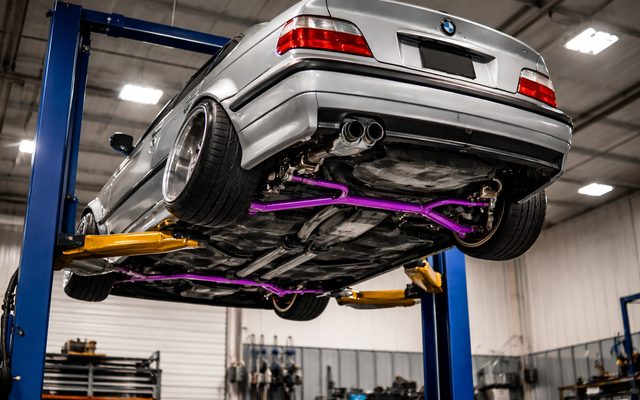
The foundation of any exceptional drift machine is, indisputably, the platform itself. Several vehicles have attained iconic reputation within the worldwide oversteer scene due to their natural handling characteristics, durable design, and the enormous availability of performance parts available. Choosing the correct car is the initial and most significant choice a builder will make. For instance, the BMW's E36 3 Series is universally acknowledged as among the finest overall cars for drifting of all time. Its excellent 50/50 weight distribution, coupled with a RWD configuration and bulletproof straight-six engines, establishes a platform that is simultaneously forgiving for newcomers and extremely effective in the hands of a professional pilot. The evolution of this lineage, the BMW E46 platform, refines these attributes with a more developed structure, wider stance for improved high-speed stability, and yet increased lock straight from the OEM. A different formidable option in the pro arena is the Corvette C6.
This V8-powered sports car offers a unique combination of advantages to the sideways world, featuring a lightweight aluminium chassis, a backwards-positioned transaxle that helps create an ideal weight distribution, and the tremendous low-end power of a large-displacement LS V8 motor. This fusion transforms it into an utter force on track, designed of initiating and sustaining long angles with apparently effortless deployment of power. For those desiring outstanding bang-for-the-buck, the Nissan 350Z stands out as a top-tier candidate. It arrives from the factory with a rigid platform, a competent factory LSD, and the smooth VQ series engine that provides sufficient performance for learning and advancing in the activity. Its follow-up, the Nissan Z34, brings further refinements in structural rigidity, suspension design, and peak powerplant performance, establishing its status as a common pick among professional pilots. Other iconic vehicles that warrant attention include the lightweight rotary-powered Mazda FC RX-7, the most popular Nissan S13, the American Ford SN95, the electronic-equipped E90 3 Series, and the tiny yet surprisingly engaging and teachable Mazda Miata. Each of these chassis gives a unique palette of traits, difficulties, and potentials, but they all share the basic components required to become a competitive sliding vehicle.
However, picking the correct chassis is just the first step. To release the true performance of any of these vehicles, major upgrades to the steering geometry and damping and springing systems are absolutely essential. This is where the realm of precision drift-spec parts comes into critical focus. The most most impactful upgrade for a serious drift machine is the integration of a drift-spec drift angle kit. These advanced systems, like those manufactured by performance brands like specialist manufacturers, are designed to dramatically enhance the chassis's possible lock-to-lock rotation. A OEM road car is highly constrained in how far its front wheels can turn, a design compromise for daily operation. In drifting, conversely, aggressive steering input is frequently needed to manage and hold a drift. An steering kit substitutes the stock hubs, rod ends, and often suspension arms with components that allow the steered wheels to attain steering lock beyond 70 or even 80 degs, versus a typical OEM angle of around 40 to 50 degs.
This immensely increased capability offers the pilot with exponentially enhanced authority during a slide, making it far easier to begin a drift, sustain it through a sweeping turn, and transition fluidly from one angle to another. The improvement in handling is nothing short of profound. Coupled with a properly specified steering kit is the every bit as essential upgrade to the chassis's damping system. Generic or including expensive road adjustable suspension are simply not intended for the specific and extreme needs of sliding. A purpose-built pair of adjustable dampers is of utmost importance. These specific suspension components incorporate custom damping rates and spring strength that are tuned for the violent mass transition that is typical of sliding. When a pilot initiates a drift, the vehicle's mass is thrown forcefully to the outer of the turn. Proper drift-spec dampers handle this transfer in a consistent fashion, permitting the car to find its balance quickly and offering the driver accurate feedback through the wheel and cockpit. They also provide precise tuning of ground clearance, shock absorber stiffness, and cross-weight, which are all key elements of fine-tuning the vehicle's behavior to a particular track or piloting approach. As a system, a high-quality steering angle kit and a properly selected pair of drift-spec adjustable dampers constitute the undeniable mechanical foundation upon which all subsequent tuning is based.
Once the essential components is fitted, the following critical stage in the development is the detailed adjustment of the chassis's suspension geometry. This is the domain of chassis dynamics adjustment, a methodology that can seem intimidating to the newcomer but is, in practice, the key to converting a assembly of high-performance components into a unified and consistent vehicle. The most debated element of alignment for sliding is certainly camber. Wheel camber is the tilt of the wheel compared to the perfectly straight line when looked at from the front-on of the chassis. If the top edge of the wheel is tilted towards the car, this is referred to as negative camber. For drifting, an inward tilt on the front axle wheels is generally used and is considered essential. The purpose is fundamentally linked to tire contact.
When a car is cornering at extreme sideways angles, the frame leans towards the outside of the turn. This lean makes the outer front tire to reduce its optimal contact patch with the asphalt. By adding negative camber, the wheel is pre-angled to account for this lean. As the car tilts into the turn, the tire gains a better contact patch on the road surface, increasing its grip at the exact moment when it is absolutely essential for steering authority. Typically, front axle camber settings for a competition drift car fall between approximately -3 degrees to as much as -5 degrees or even beyond, contingent on the specifics of the vehicle setup, tire type, and driver style. The rear wheels also use inward tilt, but the values are typically less and less aggressive than the front. Overly aggressive inward lean at the back can cause the vehicle to overly tail-happy and difficult to manage on throttle input, as it shrinks the effective contact patch of the powered tires during straight-line power delivery. Hence, rear axle camber settings are frequently in the vicinity of -1 degree to -3 degrees, achieving a precise balance between offering sufficient cornering bite to help in initiating and holding the slide while also keeping effective traction for acceleration the bend. Camber is just one part of the broader suspension geometry equation, which furthermore involves toe setting, caster, and bump steer correction.
Toe describes the direction of the wheels as seen from the top. Inward toe means the front edges of the wheels are closer together than the rear edges, while outward toe means the reverse. For sliding, a slight amount of front toe out is often used to sharpen the initial steering feel, making the chassis feel more responsive and willing to start a drift. Rear toe is typically set to neutral or a incredibly small amount of inward toe to promote stability under throttle. self-centering is the longitudinal or backwards tilt of the steering axis when viewed from the side of the chassis. Increased positive caster increases self-centering and stability confidence, and it also increases camber increase during cornering, which is extremely advantageous. Adjusting these values is a intricate interplay where a modification to a single setting can and often will impact the others. The conventional approach for setting a vehicle's alignment for competition has historically been a time-consuming process of experimentation and feeling. A pilot or team would apply a change based on a hunch, drive the chassis on track, use the operator's personal perception and comments, and then introduce a further tweak. This loop would iterate again and again until the chassis felt "good" or the scheduled track session ran out. This approach is not just incredibly slow in terms of time and resources, but it is also fundamentally inaccurate.
Human perception is a famously unreliable measurement tool, influenced by numerous elements such as fatigue, varying track grip levels, temperature, and simply the mindset of the operator on that particular session. What feels "tail-happy" on one lap might feel "understeery" on the following pass, leading to conflicting information and counterproductive adjustments. This long-standing problem in chassis setup is exactly where state-of-the-art technology has intervened to completely change the landscape.
The advent and integration of advanced drift telemetry software has introduced a radically different era for building and optimizing high-performance drift machines. These tools, represented by groundbreaking systems like data acquisition tools, work by actively recording the actual dynamic performance of the chassis as it is piloted on the course. As opposed to depending on personal impression, these systems collect objective data on key parameters such as suspension travel, wheel speed, lateral and longitudinal g-forces, steering angle, and throttle and brake application. This acquired telemetry is then analyzed by advanced software that can visualize and decode the data in a comprehensible manner. For the first time, drivers and crews can observe exactly what the chassis is performing at any given millisecond of a drift. This function revolutionizes the whole suspension tuning workflow. Think about the specific goal of optimizing the front negative camber for a specific car. As an alternative to applying a change from -3 degrees to -3.5 degrees and then running several laps to try and "sense" a difference, a telemetry system can deliver immediate and definitive feedback. The tool can display in a chart how the wheel's loading is performing during the critical stages of a drift: turn-in, sustain, and changing direction. It can show if the present angle is permitting the steering tire to achieve optimal loading or if the tire is working inefficiently on its outer edge.
The software can then suggest data-driven suggestions for modification. Perhaps the data reveals that the tire is still overworking its outer shoulder at -3.5 degrees of camber, implying that even more inward lean, say -4 degrees, might drift angle kits be warranted. Conversely, the data might indicate that the tread is not reaching temperature or that the inner edge is degrading excessively, which could suggest that there is excessive angle and a slight reduction back to -3.2 degrees would be better efficient. This standard of precision and useful intelligence was completely impossible in the era of pure manual setup.
The benefit of employing a dedicated vehicle dynamics tool goes well beyond just setting alignment. It functions as an essential coilover setup tips that is tailored to your exact car. When fine-tuning the shock absorber settings on your coilovers, instead of relying on vague advice or copying another driver's setup, you can use the software to analyze how the vehicle is behaving in response to your adjustments. The software can graph the wheel movement data over a section of track, highlighting if the shocks are controlling the weight transfer optimally or if they are permitting the car to bounce uncontrollably after a direction change. It can help in pinpointing problems like hitting the bump stops or topping out, enabling you to introduce educated decisions to helper springs, rebound/compression rates, or stance. This methodology extends just as well to the complex art of suspension geometry optimization. In addition to camber, the system can give insight into how adjustments to toe and caster angle are affecting the car's stability during various maneuvers of a slide. For instance, it can assist you to find the optimal amount of front axle toe-out for your specific angle kit configuration and driving technique by showing the quickness of turn-in response and the consistency of the vehicle at full countersteer. This makes the tool an exceptionally powerful performance drift suspension tuning guide optimization handbook that is dynamically informed by the live performance of your personal vehicle on the tarmac. It moves the whole project from a mysterious craft into a scientific engineering exercise.
Moreover, the value of a tool like GripDial is not restricted to expert engineers with extensive budgets. For the grassroots enthusiast, it functions as an incredible equalizer. It practically offers the tuner with the analysis of a expert suspension specialist without the associated cost. It speeds up the development time by giving unambiguous solutions to problems that would traditionally take years of trial and error to answer. A builder can understand how their particular car responds to different inputs, building a deeper understanding of vehicle dynamics in the journey. It also opens up professional performance tuning techniques, enabling every enthusiast with the drive to refine their machine to accomplish it in a systematic and productive way. This is especially important in a sport like oversteer competition, where engineering know-how has historically been a closely guarded commodity among professional crews. Today, that knowledge can be in the toolkit of any dedicated builder.
In summary, the journey to constructing and dialing in the ultimate high-performance drift machine is a multi-stage mission that seamlessly combines proven engineering principles with 21st-century data technology. It starts with the strategic choice of a legendary platform, then enhanced by the application of essential performance hardware like maximum-angle angle modification systems and correctly valved competition coilovers. The journey then moves into the intricate stage of alignment optimization, where values like camber, toe setting, and caster angle are carefully configured to match the car's upgraded capabilities and the driver's individual needs. Ultimately, and what drift tuning app genuinely differentiates the modern methodology from the traditional methods, is the integration of a advanced suspension tuning application. This system eradicates the uncertainty and trial and error of only subjective setup by delivering empirical, actual data on how the car is really functioning. It acts as an incredible diagnostic aid, a definitive alignment optimization handbook, and a master vehicle dynamics tool. In unison, this complete philosophy leads to that all component of the drift car—from the pick of the chassis to the final click on the damper—is optimized for maximum performance on the circuit. It embodies the total evolution of the art of oversteer driving, merging physical pilot talent with data-informed vehicle setup to build the ultimate effective machines attainable.